Urban Air Quality (Urban-AQ) is a critical issue facing Southeast Asian cities, with impacts spanning atmospheric radiation budgets, regional climate shifts, and significant public health and economic burdens.
This White Paper provides an in-depth analysis of the following core pillars:
-
Radiative Forcing & Heating Rates: Investigating the magnitude of radiation budget perturbations at the surface and top of the atmosphere, specifically quantifying the contributions of Black Carbon (BC) and Brown Carbon (BrC).

Urban Heat Island effects (taken from Singh et al., 2020). - Climate Modeling & Prediction: Assessing the accuracy of regional and global models in predicting the influence of biomass burning (BB) on regional climates.
- Public Health Risk Assessment: Utilizing mathematical modeling to evaluate population exposure and employing concentration-response functions to link air pollution with adverse health outcomes, including premature death.
-
Policy & Economic Decision-Making: Providing a scientific framework that integrates population data and air quality metrics to facilitate evidence-based policy making and evaluate economic burdens.
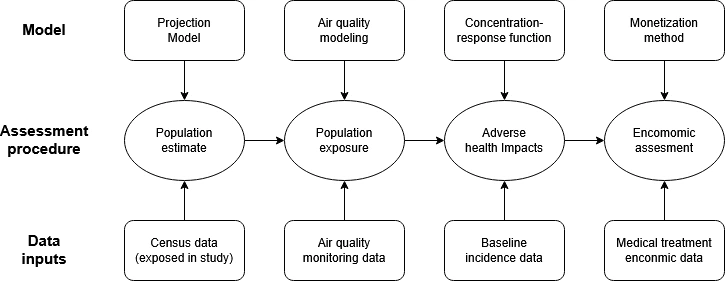
Air Pollution Health Risk Assessment Framework (taken from Hassan Bhat et al., 2021).